
Hexmark

Where should we open next?

Hexmark answers it with your own customer data, for any address in the country.

Ring report · 3 mi

142,318 people in this trade area match your customer profile. 27 competitors are already here.

Every figure opens into the arithmetic that produced it.
Three things go wrong on the way to a site decision.

Demand

Demographics look good everywhere

Population and median income said the same thing about the site that worked and the one that never did. Neither tells you whether those people buy what you're selling.

Tell Hexmark who your customers are: the ages, the income, whatever else shows up in your books. It counts those people around any address in the country.

Overlap

Your next site eats your best one

The location three miles from your strongest store looks obvious until they're both running half full, and nobody can say how much of that trade area is actually new.

Hexmark draws where each location already pulls from, so you'll see what a new site takes before you sign rather than eighteen months after.

What is already there

You meet the competition after signing

Twenty-three competitors inside three miles is a different deal from four, and nobody's counting them for you.

Every competitor in the ring, counted by what they do rather than what's on the sign, sitting next to the demand number.

The map

Any address in the country, in about a minute

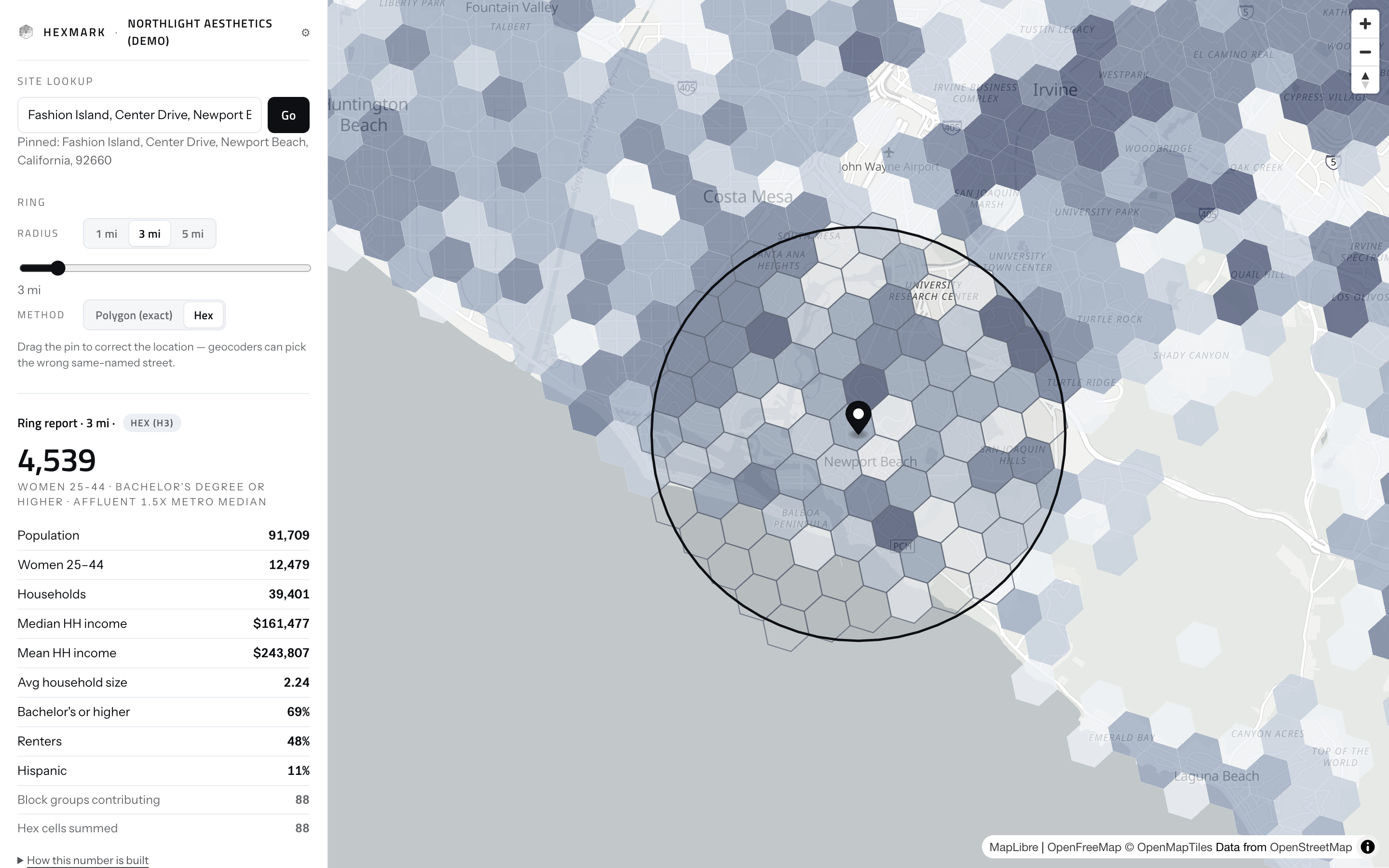
The map is shaded by how many of your people live in each area, so a market you have never visited reads at a glance. Drop a pin and the ring counts what sits inside three miles of it.

The Hexmark map: census block groups shaded by how many people match this operator's customer definition, a three mile ring around a dropped pin in Newport Beach, and the ring report beside it
Newport Beach, three mile ring. 4,539 people matching this operator\u2019s definition, and 94 competitors already inside it.
240,149
US neighborhoods
Every census block group in the country
16,160,293
Competitor locations
Counted 3 September 2026
4 weeks
To get your data in
Capped, and waived if your team does it
$1,200
Per month
Four seats, and free viewers after that

What you get

Define your customer

The ages you serve, the income it takes to afford you, and whatever else is true of the people who keep coming back.

Change it and every map and report moves with it. You're not filing a request and waiting a week.

Score any address

Type it in, pick a radius, and get how many of your people live inside that ring and what they earn.

Then do the same on the address you are weighing it against.

Map your own customers

Your customers by area, with a line from each location you run to the places it draws from.

Hexmark reads an ID and a ZIP code, and never a name or a street.

Count the competition

Every competitor inside the ring, counted by what a business does rather than what it puts on the sign.

Where we've no coverage of an area the report says so, because a zero you could mistake for an empty market is the expensive kind of wrong.

Check the state rules

What your staff may do, and what a license costs you, graded per market with the statute quoted.

Anything unconfirmed is marked unconfirmed, so your counsel knows what still needs checking.

Who it’s for

Three people will question this number before anyone signs.

The VP of Real Estate builds the case. The COO asks what it does to the stores already open. Whoever is putting up the money asks how the number was reached.

Viewers are free and unlimited, so all three are looking at the same screen, and every figure on it opens into the arithmetic behind it.

Open any number and see how it got there

Every count opens into the parts it was built from, down to the block group. When the map is estimating rather than counting, it says so on the map.

How the number is built
How this number is built
Base, women 25 to 4458,120
Affluence share, weighted41.2%
Combined, per neighborhood39.8%
Matching your profile23,132

Multiplying the ring averages gives 41.2%, not 39.8%. The count is summed block group by neighborhood, and the combined row is the one that reconciles.

Bring an address you’re weighing. We’ll run it.

Thirty minutes, your markets, your definition of a customer. If the answer isn’t useful you’ll know inside the call.